VOV- Welfare of the world

Rahu and Ketu: The Shadow Planets That Science and Vedic Astrology Both Agree On
Discover the real science behind Rahu and Ketu — the Lunar Nodes that even NASA tracks. Learn how they form, why they cause eclipses, and how they impact your life. Expert insights by Viswanatha Saraswathi, trusted Vedic astrologer in Sainikpuri, Hyderabad.
Whitewaters Digitech
3/28/20266 min read
What if the two most feared points in your horoscope aren't mythological fiction — but real, measurable, scientifically documented points in the sky? Welcome to the fascinating world of Rahu and Ketu.
What Are Rahu and Ketu? The Vedic Astrology View
In Vedic astrology, Rahu and Ketu are considered two of the most powerful and transformative forces in your birth chart. Unlike the Sun, Moon, Mars, or Saturn — which are physical celestial bodies — Rahu and Ketu are shadow planets, also called Chaya Grahas in Sanskrit.
They are not planets you can point a telescope at. And yet, every experienced astrologer — including Viswanatha Saraswathi, a trusted name in Vedic astrology consultations in Hyderabad and Sainikpuri — will tell you that Rahu and Ketu have some of the deepest karmic influence in any horoscope.
But here is the question thousands of people in Hyderabad search for every month:
"Are Rahu and Ketu real? What is the science behind Rahu Ketu?"
The answer will surprise you — because modern astronomy actually validates their existence. Not as demons, not as mythological serpents — but as real, precise, mathematically calculated points in space.
The Science Behind Rahu and Ketu: What Astronomy Says
Here is where ancient wisdom meets modern science in a beautiful way.
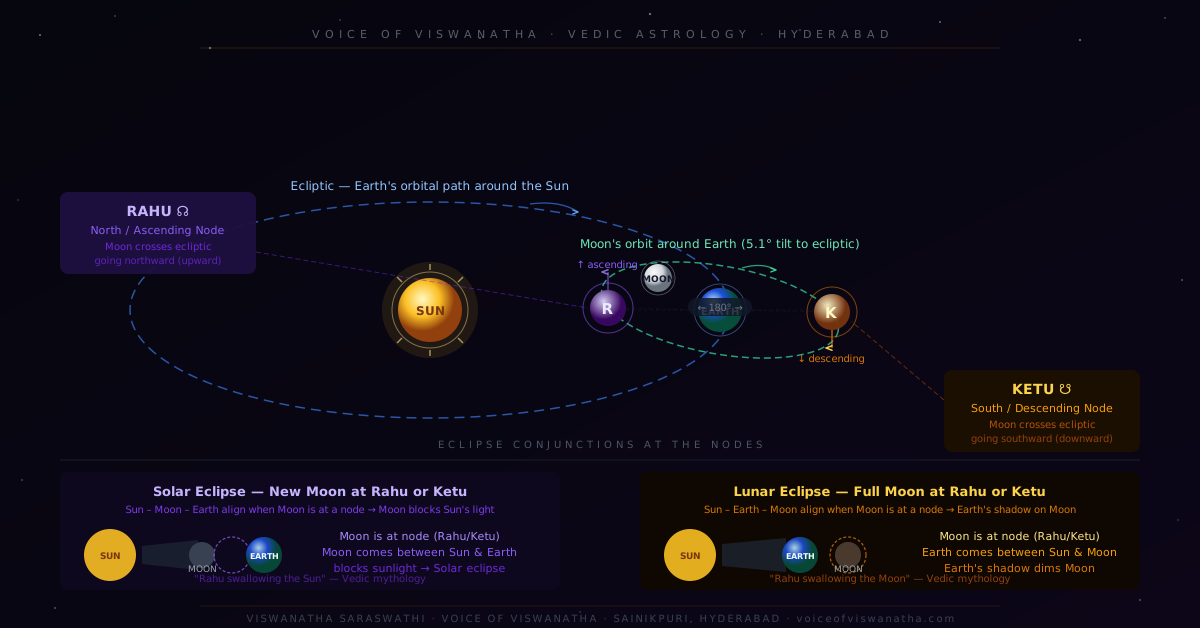
The Earth orbits the Sun. The Moon orbits the Earth. These two orbital paths are not identical — they are tilted at an angle of approximately 5.1 degrees to each other.
These two orbital paths intersect at exactly two points in the sky. Astronomers call these points the Lunar Nodes:
The North Lunar Node (Moon's ascending node) → This is Rahu
The South Lunar Node (Moon's descending node) → This is Ketu
These are not imaginary. NASA tracks them. Space agencies around the world calculate them. Every astronomer studying the Moon's orbit accounts for them. The Lunar Nodes are as real and measurable as the Moon itself.
Why Do Rahu and Ketu Cause Eclipses?
This is where science becomes truly spectacular.
A solar or lunar eclipse only happens when the Sun, Moon, and Earth align — and that alignment can only happen when the Moon is near Rahu or Ketu. This is not coincidence. This is orbital mechanics.
A Solar Eclipse (Surya Grahan) occurs when a New Moon happens near Rahu or Ketu
A Lunar Eclipse (Chandra Grahan) occurs when a Full Moon happens near Rahu or Ketu
Ancient Vedic astrologers understood this thousands of years ago — long before telescopes existed. They called it Rahu "swallowing" the Sun or Moon. Modern astronomy calls it a nodal eclipse cycle. Different words. Same phenomenon.
That is why, in both science and Vedic astrology, Rahu and Ketu are always placed exactly 180 degrees apart in your birth chart. Because the two lunar nodes are always directly opposite each other in space. Always.
How Rahu and Ketu Are Formed: The Orbital Story
To understand Rahu and Ketu scientifically, picture this:
Imagine you are standing at the center of a giant clock. The Sun slowly moves along the outer ring of numbers (this is called the Ecliptic). The Moon moves on a slightly tilted ring, crossing the Ecliptic twice each month.
Each time the Moon crosses from below the Ecliptic to above it, that crossing point is Rahu. Each time it crosses from above to below, that point is Ketu. These crossing points slowly drift backwards along the zodiac, completing one full revolution every 18.6 years — which is why the Rahu-Ketu transit cycle in Vedic astrology is also approximately 18 months per sign.
This 18.6-year Lunar Nodal Cycle is one of the most studied cycles in astronomy. It affects ocean tides, weather patterns, and has been linked to agricultural cycles across civilisations. The ancient Vedic sages who embedded Rahu and Ketu into the horoscope system were working with observational astronomy of the highest order.
So Why Do Rahu and Ketu Affect Humans? The Science of Gravitational Influence
Here is where many people ask: "Even if Rahu and Ketu are real orbital points, how can they affect a person's life?"
This is a fair question. Consider this:
The Moon's gravity affects the Earth's oceans, creating tides that can shift billions of tonnes of water twice a day. The human body is roughly 60–70% water. If the Moon's gravitational pull is powerful enough to move oceans, it is not a stretch to explore how lunar cycles — and the critical nodal points where those cycles intersect with the Sun's path — could have measurable biological and psychological effects.
Research in chronobiology (the study of biological rhythms) has consistently shown links between lunar cycles and human sleep patterns, hormonal rhythms, and even surgical outcomes. During eclipse periods, when the Sun, Moon, and Lunar Nodes perfectly align, the combined gravitational geometry is unique and measurable.
Vedic astrology takes this further — arguing that the karmic significance of where Rahu and Ketu fall in your birth chart (called the Rahu Ketu axis) reveals the direction of your soul's evolution in this lifetime.
Rahu Ketu Axis in 2026: What It Means for You
The Rahu–Ketu axis is currently transiting the Aquarius–Leo axis in 2026. According to both modern astrological trends and the calculations followed at Voice of Viswanatha, this is one of the most spiritually charged Rahu-Ketu transits in recent memory.
Rahu in Aquarius pushes collective humanity toward innovation, community, and technological evolution — but can also create confusion, obsession with the digital world, and detachment from roots.
Ketu in Leo strips away ego, fame, and attachment to personal recognition — asking each of us to surrender leadership games and seek genuine inner wisdom.
For individuals with Moon signs or Ascendants in Leo, Aquarius, Taurus, or Scorpio, this transit demands particular attention. A personalised Rahu-Ketu horoscope reading can reveal exactly how this axis is activating your chart.
Should You Fear Rahu and Ketu?
This is perhaps the most important question — and the one Viswanatha Saraswathi is asked most often during consultations in Sainikpuri and across Hyderabad.
The honest answer is: No. But you should respect them.
Rahu and Ketu are not malevolent cosmic villains. In Vedic astrology, they are karmic architects. Rahu represents your soul's hunger — the desire to experience, expand, and acquire what it hasn't mastered in past lives. Ketu represents accumulated wisdom — things your soul already understands, sometimes so deeply that detachment follows naturally.
A well-placed Rahu can bring extraordinary worldly success, fame, and breakthroughs in unexpected fields. A strong Ketu can bestow deep spiritual insight, healing abilities, and moksha-oriented consciousness.
Understanding your personal Rahu-Ketu placement — through a detailed Vedic birth chart reading — is not about fear. It is about self-knowledge.
Frequently Asked Questions About Rahu and Ketu
Q: What is the scientific name for Rahu and Ketu? Rahu is the North Lunar Node and Ketu is the South Lunar Node — the two points where the Moon's orbit intersects the Earth's orbital plane around the Sun.
Q: Do Rahu and Ketu move through all 12 zodiac signs? Yes. Together, Rahu and Ketu complete one full transit of the zodiac every 18–19 years, spending approximately 18 months in each sign.
Q: Why are Rahu and Ketu always opposite each other? Because they are the two intersection points of the same pair of orbital paths, they are always geometrically 180 degrees apart.
Q: Can Rahu Ketu cause health problems? In Vedic astrology, a Rahu-Ketu transit or dasha affecting the 6th, 8th, or 12th house can signal health vulnerabilities. However, these are karmic indicators — not certainties. Remedies, awareness, and lifestyle alignment can significantly reduce negative outcomes.
Q: Where can I get a Rahu Ketu horoscope reading in Hyderabad? Voice of Viswanatha, led by astrologer Viswanatha Saraswathi in Sainikpuri, Hyderabad, offers detailed Rahu-Ketu transit analysis and personalized birth chart consultations.
Conclusion: Where Ancient Wisdom and Modern Science Shake Hands
Rahu and Ketu are not superstition. They are ancient India's way of naming something that modern astronomy has independently confirmed — the Lunar Nodal Points, the gatekeepers of every eclipse, the architects of an 18.6-year cosmic cycle that affects tides, seasons, and according to centuries of Vedic observation, the trajectory of human lives.
To dismiss Rahu and Ketu is to dismiss the precision of Vedic astronomy. To understand them is to unlock one of the most self-revealing tools in the entire corpus of Jyotish.
Whether you are a believer in Vedic astrology, a curious skeptic, or somewhere in between — the science is real. The nodes exist. And what you do with that awareness is entirely your choice.
✨ Ready to understand your own Rahu-Ketu axis and its impact on your career, relationships, health, and spiritual path?
Connect with Viswanatha Saraswathi at Voice of Viswanatha — a trusted Vedic astrologer serving clients in Sainikpuri, Secunderabad, and across Hyderabad. Book a personalised Rahu-Ketu horoscope consultation today.
📍 Location: Sainikpuri, Hyderabad, Telangana 🌐 Website: www.voiceofviswanatha.com